 Deck Study
Arkhite embodies the main appeal of many Brandt Gate decks: using a complex engine between multiple zones to assemble the perfect board. Using her ride line, you search your deck for Torrential Energy Research which looks at the top five cards of your deck for “Monster” units. You put one into hand, and the other goes into drop which you “research” by putting them into the order zone. You’ll do two things with researched Monsters: call them directly from the order zone for board-building and extra attacks (skill 4), and discard any duplicate Monsters to increase the power of the ones you call (skill 3). These abilities force you to play the mad scientist, where you tinker and fine-tune your gameplay until your master plan is complete.
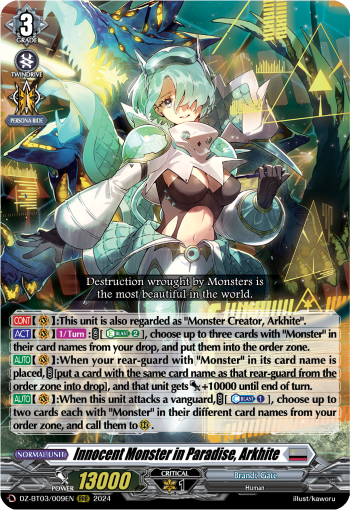
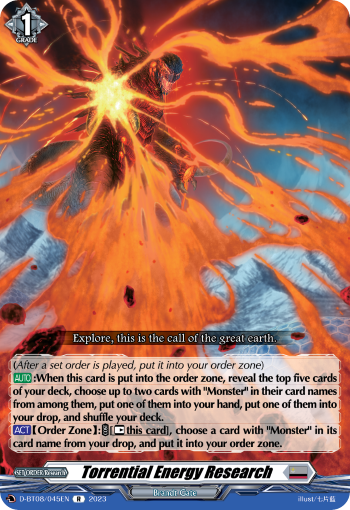
There are enough Monsters in Brandt Gate such that you can run 30 Monsters and four TER. You do not need to worry about seeing Monsters off of TER’s top five check. Instead, let’s look at it the other way: how many non-Monsters can we run before there’s a problem?
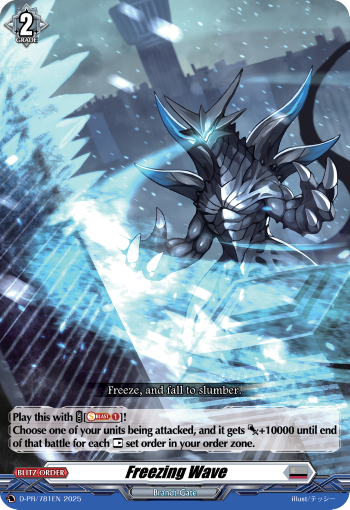
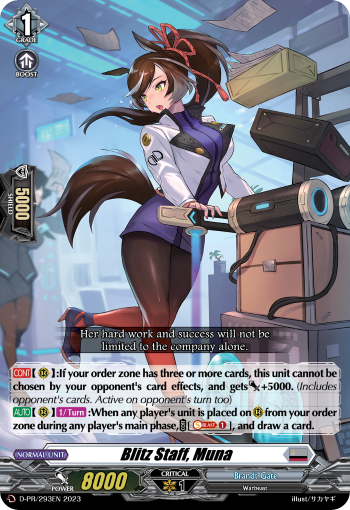
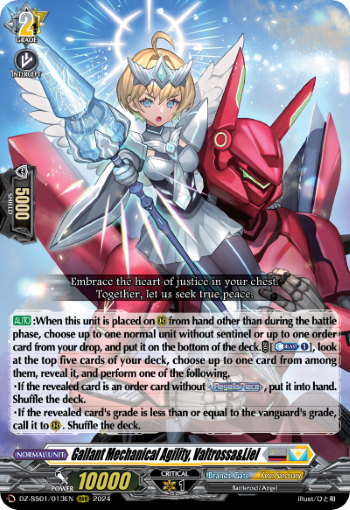
There are a decent number of non-Monster options which Arkhite can make use of:
- Freezing Wave is a 10k shield for every rested order you have, and since you have to rest TER to research, you can treat it like a pseudo-Sentinel.
- Blitz Staff, Muna lets draws a card whenever a unit is called from the order zone. This is commonly played in Prison since you can draw from your opponent freeing their units, but you can also benefit by drawing an extra card from turn 3 onward for a Soul-Blast.
- Both Valtrossa&Liel and Baldareid can provide the deck with a boost of consistency by potentially fetching an TER or grabbing a missing Monster. Baldareid can provide soul and potentially grab a persona ride, while Valtrossa&Liel can find the grade 1 Monsters which support the deck.
- There’s basically no reason to not have a Regalis Piece in your deck, since at worst you can run the Fire Regalis and get a free draw.
While there’s no material cost, there is the risk of not having enough Monsters to research if you run too many of these cards. You can imagine playing TER, looking at the top five, seeing a mix of triggers and these cards, and being accidentally minus because they could have been Monsters. You have to wonder where the deck-building line is where your greed starts to take a toll on the deck’s consistency.
Simulations
We can try to answer this question using simulations. I’ve written a program in Python which plays an automated game of Vanguard against an imaginary opponent (a digital version of playing Solitaire, which you’ve probably done to test). Rather than guess, we can see what impact there is on running too many non-Monster units.
⚠️ Disclaimer
There is no guarantee that the results of these tests are “optimal”. Games are complex, so there are many situations where the assumptions used aren’t the best. This is meant to be informative, and help guide your own deck-building using some tangible numbers. Use your own judgment.
Measurements
What we’ll look at is the number of monsters you research over the course of a game. For example, on turn 1 you play Torrential Energy Research and reveal two Monsters. You put one in hand, the other in drop, then rest TER skill to research the Monster you you just discarded. This counts as 1. On turn 2 you do the same thing, and now you can rest two TER to research two more Monsters. The total count would be 3.
| Turn | 2 TER | 3 TER | 4 TER |
|---|---|---|---|
| 1 | +1 | +1 | +1 |
| 2 | +2 | +2 | +2 |
| 3 | +5 | +6 | +6 |
| 4 | +5 | +6 | +7 |
| Total | 13 | 15 | 16 |
The most common situation is likely seeing one TER outside of the one you search from the ride line. If you see the third TER on turn 4 instead of turn 3 you can research 14 total monsters, but you’ll probably draw that third card earlier rather than later.
The reason why I want to focus on total Monsters researched is to capture the difference in tempo. Monsters researched is Arkhite’s main resource—you make extra attacks with them, increase the power of those attacks, recur Monsters and persona rides, and more. Monsters researched on turns 1 and 2 will come up on turn 3 and 4, so not seeing Monsters in hand or in drop will have a ripple effect through the whole game. In contrast the two other decks which use TER, Eva and Edelglema, are only interested in seeing a Monster in TER’s top five check. Not Arkhite.
Model Assumptions
- Game length: We will simulate the game until turn 4. Games will either end at this point, or will develop so much complexity that they lose their broad applicability. It’s a solid baseline.
- Mulligan policy: We return all triggers drawn. We keep one persona ride, all PGs, and all copies of TER drawn. We keep all non-monster cards, since it’s assumed these are special cards we would willingly thin our deck for.
- Ride phase: we discard a Monster if we have one. We do not discard copies of Arkhite, even though we could recover them with Aux Machine Monster, Savoied. We want to count the number of times we research a Monster we would call.
- Playing Torrential Energy Research: if we have an order, we play it. We add to hand sentinels over persona rides over a Monster. We drop a persona ride over a monster, never dropping a sentinel. While we won’t discard Arkhite for ride cost, if we happen to discard one off the top to add with Savoied, we’ll take it.
- Discarding Monsters: Because it would make the model too complex to count unique Monsters, we’ll discard as many Monsters from hand at the start of each turn to meet the maximum number to research. In practice, this wouldn’t be “discarding” Monsters: you’d get them in drop by guarding, retiring from a card ability, or calling a unit to activate Arkhite’s ability. We cannot hard-code optimal play, but this will get us close to that. In addition, at the end of the turn, we’ll dump all Monsters from the order zone into the drop. Again, this could happen for multiple reasons.
Variables to Test
- There’s two extreme mulligans I want to check: one where we return all Monsters in the mulligan, and one where we keep all Monsters. We want to discard Monsters from our hand in the ride phase so there’s something in drop to research, but we also want Monsters in deck so that TER doesn’t whiff. We’ll compare both to see how stark the difference is.
- We’ll run simulations for 0 to 8 non-Monster cards. We’ll look at both the average number of monsters researched and the modal number (the most common number of monsters researched).
Intial Results
Running simulations for each combination, we get the following averages and modes:
| Non-Monsters | Keep Monsters | Return Monsters |
|---|---|---|
| 0 | 14.0354 | 13.6896 |
| 1 | 13.8953 | 13.4836 |
| 2 | 13.7319 | 13.2536 |
| 3 | 13.5346 | 13.0020 |
| 4 | 13.3115 | 12.7286 |
| 5 | 13.0612 | 12.4286 |
| 6 | 12.7741 | 12.1074 |
| 7 | 12.4602 | 11.7519 |
| 8 | 12.0978 | 11.3657 |
Okay! There’s around a half a card difference in the average mulligan, with the more conservative mulligan being favored. As you add more non-Monsters to the deck, that gap widens to almost a whole-card difference. Seems like keeping Monsters in hand to discard and call helps more than sending them back to the deck.
Also, I put both the average and the mode (the most common number to appear). Highlighted in green are the number of non-Monsters where researching 15 monsters is the most likely event to happen; yellow is where researching 13 is the most likely; and red is where 12 is the most likely.
To me, using the mode is the cleanest way to make a cutoff. The reason why is that the average represents the results over multiple games; it’s calculated by adding the possible results of a game, weighted by their odds of happening. However, researching 16 Monsters in one game doesn’t “made up for” researching 10 in another. You’d rather get 16 in every game, you know?
Instead, I think it makes the most sense to look at what happens most often, and define a range of safe numbers to play based on that. From the looks of it, you can run up to eight non-Monsters without the mode dipping below 13. If consistency is your biggest concern, you wouldn’t run more than two, but if you’re willing to take a hit in consistency so you can have more diverse options, running up to eight is probably fine.
Pantera the Slasher
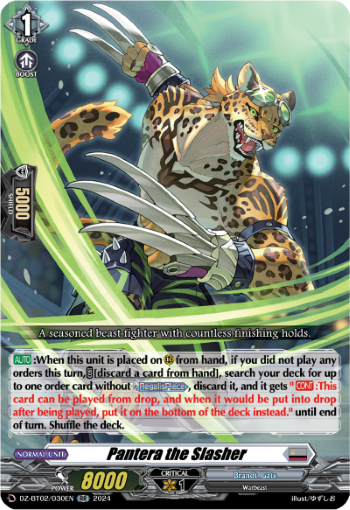
Of course, I can’t talk about Arkhite without mentioning Pantera the Slasher. He’s not a Monster, but his discard ability lets him act like a 5th copy of TER in the deck. Arkhite wants Monsters in the drop zone, and there’s some built-in discard synergies, so he’s a perfect fit. If we’re wanting to measure the We can’t talk about consistency without seeing what effect he has on deck-building (you could also run Abent Robust but this ain’t about him).
We’ll look at the same measurements for 1 to 4 copies of Pantera the Slasher, and one to six additional non-Monsters. It’s possible running Pantera offers some flexibility and lets us sneak in an extra tech choice. For the mulligan, we’ll keep up to one copy of Pantera, and we’ll stick with the conservative mulligan and keep all Monsters drawn.
| 0 | 1 | 2 | 3 | 4 | 5 | 6 | |
|---|---|---|---|---|---|---|---|
| 0 Pantera | 14.0354 | 13.8953 | 13.7319 | 13.5346 | 13.3115 | 13.0612 | 12.7741 |
| 1 Pantera | 14.2304 | 14.0664 | 13.8746 | 13.6478 | 13.3923 | 13.1117 | 12.7850 |
| 2 Pantera | 14.3319 | 14.1352 | 13.9199 | 13.6631 | 13.3759 | 13.0469 | 12.6868 |
| 3 Pantera | 14.3480 | 14.1231 | 13.8746 | 13.5797 | 13.2590 | 12.8921 | 12.4780 |
| 4 Pantera | 14.2884 | 14.0379 | 13.7463 | 13.4192 | 13.0477 | 12.6344 | 12.1608 |
It looks like Pantera doesn’t count toward the non-Monster count, and you can run a little more non-Monsters with the added boost in consistency.
First, take a look at the 0 column: every Pantera you add increases the consistency up until 3. The fourth copy actually drops the average. If you run a non-Monster the average is maximized at 2 instead of 3, and that pattern holds up until four non-Monsters.
If you’re willing to take the hit in consistency, you can probably run up to three non-Monsters before it becomes noticeable. That’s if you decide to run Pantera the Slasher.
Top Five Searchers
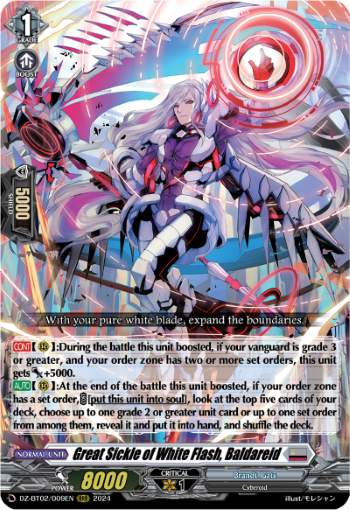
But what about the top five searchers like Valtrossa&Liel and Baldareid? Because they can grab Monsters and potentially a set order, they should also improve the consistency of the deck. How do they stack up against Pantera the Slasher?
We’ll see how specifically Valtrossa&Liel compare: once per turn, we’ll call one from hand, and prefer to add a set order over calling a Monster. We’ll keep just one in hand during the mulligan, like Pantera the Slasher.
| 0 | 1 | 2 | 3 | 4 | |
|---|---|---|---|---|---|
| 0 V&L | 14.0354 | 13.8953 | 13.7319 | 13.5346 | 13.3115 |
| 1 V&L | 14.0605 | 13.9119 | 13.7265 | 13.5140 | 13.2683 |
| 2 V&L | 14.0738 | 13.9068 | 13.7070 | 13.4738 | 13.20563 |
| 3 V&L | 14.0637 | 13.8743 | 13.6616 | 13.3989 | 13.0970 |
| 4 V&L | 14.0315 | 13.8232 | 13.5709 | 13.2833 | 12.9616 |
These results might look middling, but this is because we’re only looking at number of monsters researched. Notice that, if you don’t use any other non-Monsters, the averages basically don’t change as you add copies. There’s a decrease once you include other non-Monsters, yet the variation is still minor. Valtrossa&Liel have almost no effect on the average Monsters researched.
But, that’s not the only thing you’d get from running them, is it? Rather than having a diverse number of Monsters, the Monsters you do run will appear more often. This is true for both Valtrossa&Liel and Baldareid; the deck can use a decent amount of soul because of Savoied, so having something besides Bobalmine to send to soul is extremely useful. If you run two or three copies of either, the mode stays at 15; as if you never ran them at all.
Conclusion
Based on the tables and discussions above, I think we can safely set these as limits:
- You can run up to two Pantera the Slasher to consistently get TER without hurting the number of Monsters researched.
- You can run up to three copies of some type of top-five searcher, like Valtrossa&Liel, Baldareid, or the Fire Regalis, and it won’t have any effect on Monsters researched while still providing card advantage and consistency.
- You can run up to two non-Monsters besides the top-five searchers and Pantera the Slasher before the number of Monsters researched takes a severe hit (severe meaning the mode dips to 13 or below).
Here’s an example of how we could put these ideas into practice:




Would I call this decklist optimal? Definitely not. But it does outline the limits of what you could get away with in Arkhite without breaking the deck. If I were tuning this list, I would use “up to five searchers, up to two non-Monsters” as a rule to prevent me from making overambitious tech choices.