 Theory
Deck-building is inherently about minimizing waste.
Regardless of the game, your deck is informed by how you can efficiently spend the resources you’re given. To avoid wasting mana in Magic: the Gathering, you adjust your deck’s “mana curve” so you’re likely to spend it all every turn.1 To avoid wasting your normal summon in Yu-Gi-Oh!, you play enough monsters to normal summon while minimizing the chance of drawing duplicates.2 The principle is the same: you balance your deck according to your in-game opportunities.
We can apply the same idea to Vanguard. While we aren’t subject to mana costs or limited summons, we do have limits on normal orders, rear-guards, grade, and specific actions. Here, we’ll look at a specific area we can optimize—the amount of cards we want to discard to ride.
Ride Fodder

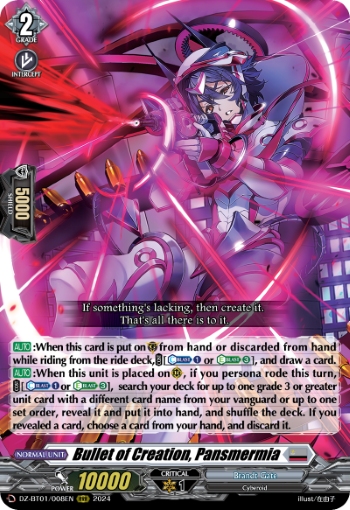

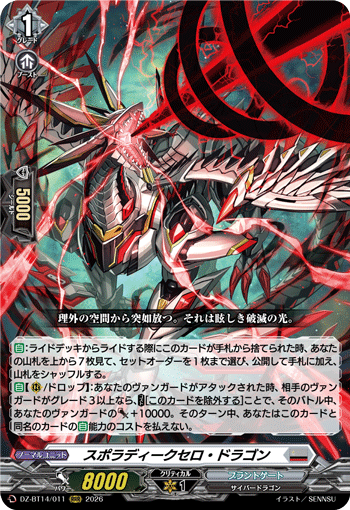
Ride fodder refers to any card that’s an ideal candidate for discarding to ride from the ride deck. Some obvious examples are the soul, gun, and rainbow cycle of grade 2s, whose skills activate during that timing. I would also include orders that are playable from drop (e.g. Alfini Svatobogi, High Five!, The Nebula Knight’s Path or NKO) and units which grant free advantage from the drop (e.g. Imigrar, Merctica, Beslutein). Ride fodder is a broad label, because it’s categorizing a role and not a specific ability: does this card have as much value when discarded as it does in hand? If the answer is no, it doesn’t count.
It’s a necessary category to consider because every deck has to discard to ride. No matter the deck, there will always be two to three cards in your hand that you are forced to ignore. They’re as good as being in the damage zone. The opportunity cost for discarding any given card is high. In contrast, ride fodder has little to no opportunity cost—if they’re as good in the drop as they are in your hand, then it’s like you’ve drawn an extra three cards for free.
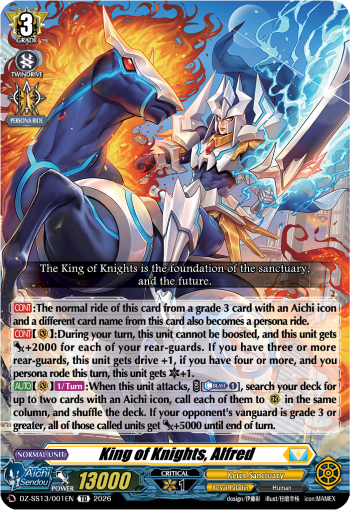
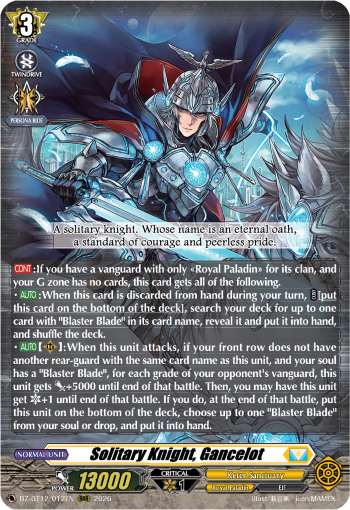

Aichicon is a relevant example of this. The list that took 1st place at BSF Long Beach 2026 (courtesy of VG-Paradox) runs four Gancelot, an Aichi Gallatin, four Lien, the Fire Regalis, and three NKO. That’s a total of thirteen effects—a fourth of the deck—which are ideal to discard. The other topping Aichicon lists have similar ratios, within a card or two.
Lien especially lets you abuse these cards, since her draw-and-discard effect can be activated when called from Aichi Alfred’s ability. She lets you “pay for ride cost” more often. Overall, Aichicon’s action economy is hyper-efficient; it just plays more Vanguard than the opponent.
Ride fodder is a feature of multiple Standard decks. Deeplands uses Rotting Usurp Dragon and Call of Deeplands; Liael=Odium will run a mix of grade 2 cycles and Steam Performer, La-era; Kaicon has Kai Nehalem, Belligeacro, and Scarlet Flamme; and the majority of decks default to either the Fire Regalis and Protection: Twincast as their Regalis Piece. While every deck has its own unique requirements, the role of ride fodder is near-universal. In the same way that Magic players consider removal and ramp, and Yu-Gi-Oh! players consider starters and hand traps, we as Vanguard players could consider ride fodder as a staple category in Standard.
Now, you can stuff your deck with every RRR cycle that exists, but you won’t be Aichicon. Ride fodder is great when discarded, but is outperformed by the deck’s higher quality rear-guards and orders. One of Aichicon’s strengths is that most of the archetype pulls double duty as ride fodder and board presence.
So, if you’re not him, and your cards are either ride fodder or not… how many should you play?
Expected Utility
To try to measure ride fodder’s impact, we’ll track their net utility over the first four turns.
Model description
- The deck is composed of three generic card types: trigger units, normal units, and ride fodder.
- We mulligan all trigger units in the opening hand back, and keep all normal units and ride fodder regardless of count.
- We start the game with 0 utility. In the ride phase, we prioritize ride fodder over normal and trigger units when discarding. Every time we discard ride fodder, we get +1 utility.
- We’ll end the simulation in the battle phase on turn 4, before drive checks. We get -1 utility for each ride fodder still in hand instead +1.
- Each deck will play an equal number of games going first and going second. Decks will be ranked by their average utility.
Model Justifications
What is utility?
“Utility” has many different contexts, but here it’s a measurement of opportunity cost. When we discard a ride fodder, a deck slot has been used when it would normally go to waste. A +1 utility represents one more card that’s been useful than normal.
Why does ride fodder give -1 utility in hand?
Two reasons: one practical and one theoretical.
The practical reason is it allows us to maximize. Suppose that ride fodder had some nonnegative utility in hand: for any amount we run, it’s strictly better to run one more because it increases the odds of seeing it early. The logical conclusion is to run the maximum possible amount of ride fodder, which we know is a bad idea in practice. To stop the optimizer from doing that, we have to penalize excess ride fodder.
The theoretical reason is to represent the trade-off. While it’s not a strict binary, ride fodder is generally less effective than the rest of your deck when in hand. I’m aware that ride fodder doesn’t suddenly turn off after turn 3. However, their relevance during the late-game is substantially worse. For example, if you’re playing Lianorn, top-decking a redundant copy of Sea Rumble Brave Shooter is worse than if it were a copy of Mollmoire or Silverwhite. That’s the risk we’re measuring.
Why not count the drive checks on turn 4?
Turn 4 is a solid benchmark. Either the game ends, or variance makes the game state so unique that players start to improvise. In my experience, ratios impact the early-game and one’s “opening book”, while specific card choices become important as the game grows longer and more complicated.
Either way, your drive checks will only affect the turns after. We care about the net utility on turn 4, so we can ignore the cards that are only relevant later.
Shouldn’t normal/trigger units give utility too?
They could. I’ve thought about assigning some utility to the rest of the deck, but the math works out the same. If we valued each non-ride fodder at utility, an -card hand would have a maximum of utility. Replacing a normal unit with ride fodder would lower the hand’s utility to . What is doesn’t actually matter for us; the fact it’s unit lower does.
The exception is that you would get more utility going second. Because of the extra draw and drive check on turn 1, your utility going second will always be higher than your utility going first. This can mask the effect the ride fodder has, and adds noise to the information given by statistics like the mean and mode. Rather than look at raw utility, we’re more interested in the difference in utility.
Initial Results
Thirteen decks were tested for games, each running a different amount of ride fodder. The code for the simulations can be found on my GitHub.
| Ride Fodder | Average Utility | Mode |
|---|---|---|
| 0 | 0.0000 | 0 |
| 1 | 0.1702 | 0 |
| 2 | 0.3447 | 0 |
| 3 | 0.5057 | 0 |
| 4 | 0.6696 | 1 |
| 5 | 0.8256 | 1 |
| 6 | 0.9627 | 1 |
| 7 | 1.0800 | 1 |
| 8 | 1.1802 | 1 |
| 9 | 1.2447 | 2 |
| 10 | 1.2858 | 2 |
| ⭐ 11 | 1.2906 | 2 |
| 12 | 1.2655 | 2 |
Given the parameters we outlined, it seems like eleven ride fodder maximizes expected utility. An example of this in a Kaicon deck would be four Belligearco, four Scarlet Flamme, two Kai Nehalem, and Protection: Twincast. Cutting one or two of those cards doesn’t have a noticeable effect, with a difference of at most 0.0459.
We can also divide the decks into three classes: decks where the mode (or most common utility) was +2; decks with a mode of +1; and decks with a mode of +0. If the deck plays less than four ride fodder, no benefit is the most common outcome. On the other end, you can play nine ride fodder and expect a similar benefit to running eleven.
What about extra draw?
An obvious limitation of our model is that it ignores additional card draw. The more cards you see, the more likely we draw redundant ride fodder and lower the net utility. It’s hard to find a deck that doesn’t have extra draws or drive checks. After all, plenty of ride fodder itself draws!
The first model is a good start, but can we do better?
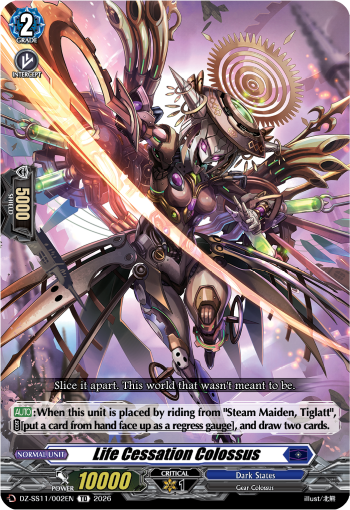

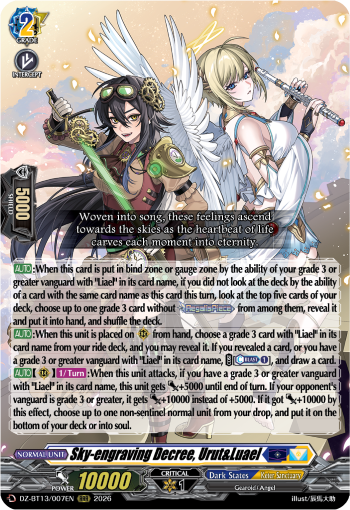
To avoid pulling numbers out of thin air, let’s use an actual deck: DZ-BT13 Liael=Odium. If we assume everything goes according to plan, you’ll see:
- Two draws from Life Cessation Colossus
- One draw on turn 3 and 4 from playing Distorted Bane
- One extra drive check on turn 3 from Liael=Odium
- One draw from persona riding Liael=Animus
- One or more draws from Urut&Luael’s call skill
- One or more draws from any extra Distorted Banes put into the regress gauge
I’m picking Odium as our reference because a.) she’s an active, meta-viable deck, so the results we get should be closer to reality; and b.) she has a higher-than-average amount of blind draw compared to the rest of the meta. In contrast, Aichicon features more filtering with Cerrgaon and Cocoa, which allows the deck to dodge redundant ride fodder. If our first model defines the upper end for ride fodder, Odium can provide a realistic lower end.
In the updated Odium-based model, we’ll perform two additional draws on turn 2, and three additional draws on turns 3 and 4. Everything else will be kept the same. Running another 200,000 simulations:
| Ride Fodder | Average Utility | Mode |
|---|---|---|
| 0 | 0.0000 | 0 |
| 1 | 0.0953 | 0 |
| 2 | 0.1767 | 0 |
| 3 | 0.2560 | 0 |
| 4 | 0.3133 | 0 |
| 5 | 0.3583 | 0 |
| ⭐ 6 | 0.3728 | 1 |
| 7 | 0.3566 | 1 |
| 8 | 0.3002 | 1 |
| 9 | 0.2164 | 1 |
| 10 | 0.0907 | 0 |
| 11 | -0.0832 | 0 |
| 12 | -0.2886 | 0 |
Discussion
What stands out to me is that, despite giving a disadvantage, the Odium-based model still wants more than a playset of ride fodder. Before running this experiment, I’d have guessed the extra draws would make ride fodder unnecessary, but that’s not the case. You can play up to nine ride fodder before it appears to have a negative effect. The utility itself is low, but remember that it’s just an estimate: their actual value in-game will be much higher.
There’s three things I’m taking away from this experiment:
① Play more ride fodder!
If you have the space, try to aim for at least six cards dedicated to ride fodder. Given that filtering and draw is common, I wouldn’t run more than ten unless the deck itself calls for it (i.e. Aichicon).
For the first couple of years of Standard, I think we mostly ran a playset of the soul cycle and called it a day. The results here suggest that the “ideal” number could be much higher than that. Four Biscotti and a Fire Regalis is, more than likely, insufficient.
② The more you draw, the less you run.
Moving from no draws at all to eight draws lowered utility across the board. The optimal amount also went from eleven down to six. That’s still a decent amount of space, but the trend is pretty clear: the more cards you see, the less you need to play.
Note that I’m specifically talking about blind draw and drive checks, and not grabbing a card off the top five or seven. The aggressive filtering and card selection you see in Keter decks will also affect your numbers, but effects which add a specific card from your deck won’t (at least, not enough to matter).
While I could thoroughly test every possible amount of draw, we have enough data for a simple deck-building heuristic:
Ride Fodder Rule of Thumb
- Play through the first four turns, and count the number of extra cards you draw.
- Starting with ten ride fodder, take one out for every two draws.
Draws 0 1 2 3 4 5 6 7 8 Fodder 10 10 9 9 8 8 7 7 6 Recommended ride fodder amounts based on the rule of thumb.
These aren’t the “correct” numbers to play, but they should be in the right ballpark.
③ You can be flexible with your ratios.
The expected utility for the optimal count and the nearby counts differ by about 5%. That’s pretty small. I wouldn’t be afraid of “incorrect” ratios since the difference is so negligible. It’ll be more productive to use the rule of thumb as a starting place, then go up or down depending on your deck’s individual needs.
More importantly, having an idea of what your deck “should” play can help in evaluating potential cards. That’s the main benefit of categories anyway. If you’re thinking of taking a copy of ride fodder out for something, imagine having to discard that card in the early-game. Are you okay with that happening? If the answer’s yes, then make the swap!